
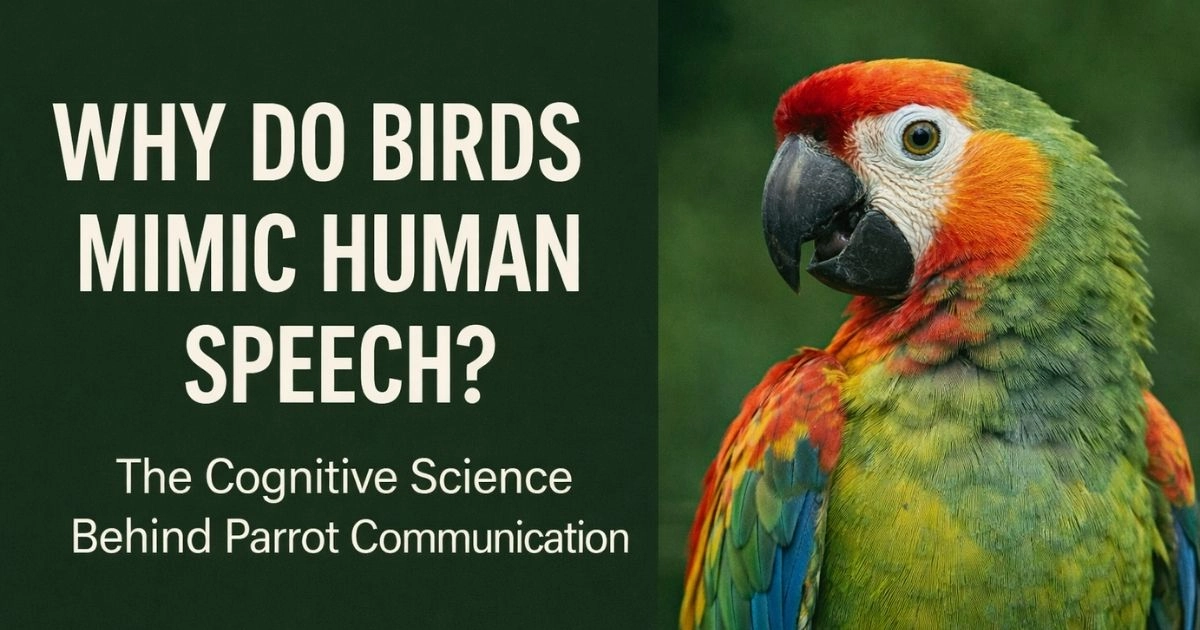
Few things amaze pet owners more than a parrot calling their name or repeating full sentences with surprising clarity. While many people assume parrots simply copy sounds without understanding them, science tells a far more interesting story. Birds that mimic human speech, especially parrots, possess advanced cognitive abilities, strong social intelligence, and specialized brain structures that allow them to learn, remember, and reproduce complex sounds. Their speech mimicry is not random—it is deeply connected to how they communicate, bond, and survive.
The Evolutionary Roots of Vocal Mimicry
Parrots evolved in social, noisy environments where communication was essential for survival. In the wild, they live in large flocks and rely on sound to stay connected, recognize individuals, warn of danger, and coordinate movement. Over time, parrots developed the ability to learn new vocal patterns, a skill known as vocal learning.
Human speech simply becomes another sound in their environment. Because parrots are wired to copy and adapt sounds to fit into their social group, they treat humans as flock members. Mimicking human speech helps them integrate socially and maintain emotional bonds.
How Parrot Brains Process Language-Like Sounds
Parrots have a highly specialized brain region associated with auditory processing and vocal control. Unlike most animals, parrots can hear a sound, analyze its structure, and then reproduce it accurately. Their brains contain a unique neural system that allows them to link sounds with meaning, emotion, and context.
Research shows that parrots don’t just repeat words; they often associate them with specific situations. A parrot saying “hello” when someone enters the room or calling a person by name demonstrates contextual learning, not mindless repetition. This ability places parrots among the most intelligent non-human communicators.
According to National Geographic, parrots use the same brain regions for vocal learning that humans use for speech, which explains why they are so effective at mimicking language-like sounds
The Role of Emotion and Social Bonding
Parrots are highly emotional and social animals. They use speech mimicry as a tool for bonding. When a parrot repeats a phrase that makes its owner laugh or respond positively, the bird learns that the sound strengthens social connection. Over time, emotionally charged words and tones become more important than random noises.
This explains why parrots often mimic voices, laughter, phone ringtones, or emotional expressions rather than neutral sounds. They are drawn to sounds that carry social value. Speech becomes a way to seek attention, comfort, or reassurance.
Why Only Certain Birds Can Mimic Speech
Not all birds can mimic human speech. Parrots, mynah birds, and some corvids possess vocal learning ability, while most birds are limited to fixed calls. Parrots also have a flexible tongue and strong beak control, allowing them to shape sounds in ways that resemble human speech.
Their long lifespan further enhances learning. Because parrots live for decades, they have more time to refine sounds, build memory, and develop complex communication patterns. This combination of brain structure, anatomy, and longevity makes parrots exceptional vocal mimics.
What Parrot Speech Really Means
Parrot speech is not true language in the human sense, but it is far from meaningless. It represents advanced learning, memory, emotional intelligence, and social awareness. When a parrot speaks, it is responding to its environment, relationships, and experiences.
Understanding this helps owners treat parrots not as novelty pets, but as intelligent companions that require mental stimulation, emotional connection, and social interaction. Speech mimicry is simply the most visible sign of a much deeper cognitive world.