
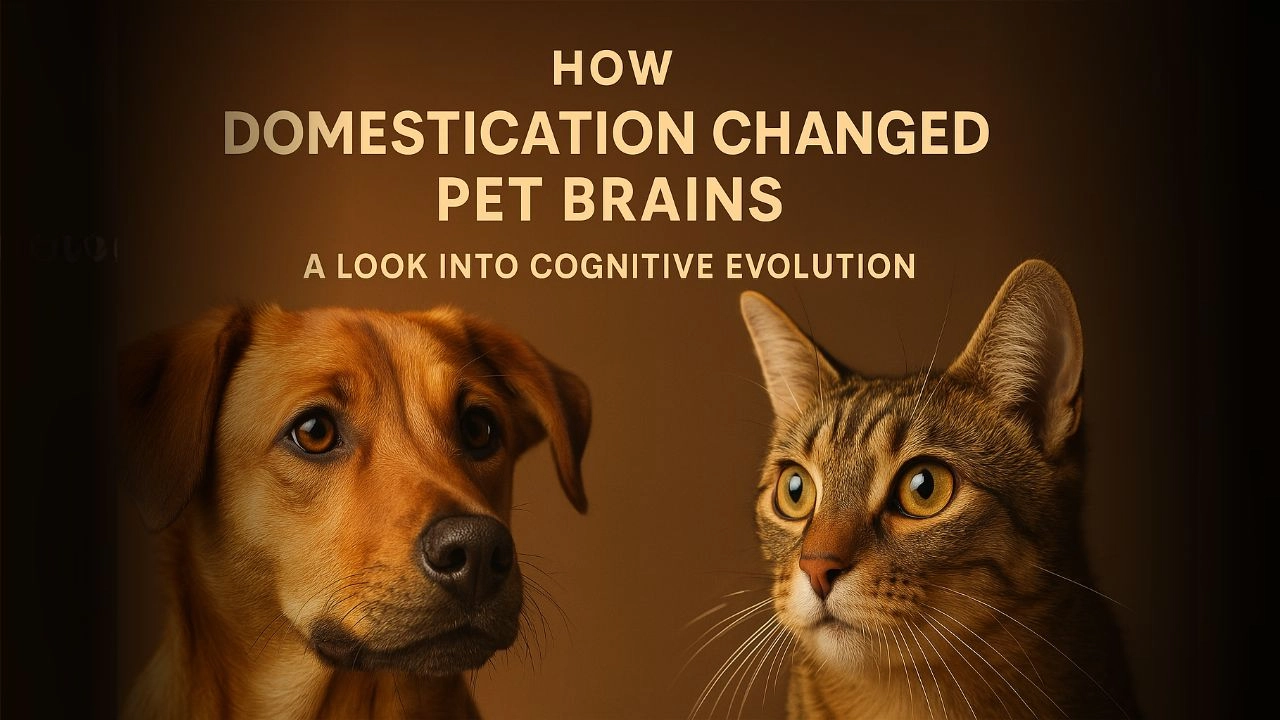
The transformation from wild animal to household companion has reshaped the brains of cats and dogs in remarkable ways. Domestication didn’t just change how pets look or behave; it altered how they think, learn and understand humans. Over thousands of years, animals that adapted best to human environments developed new cognitive skills, emotional responses and communication abilities. These changes created the intelligent, socially aware pets we know today.
Key Brain Differences in Domesticated Pets
| Brain Feature | Wild Ancestors | Modern Pets | How Domestication Changed It |
|---|---|---|---|
| Social Intelligence | Limited to pack or colony | Strong human-focused bonding | Enhanced ability to read human signals |
| Stress Response | High alertness, survival-driven | More relaxed and adaptable | Reduced fear and improved emotional stability |
| Learning Ability | Based on survival tasks | Responds to training and cues | Increased capacity for learning human rules |
| Communication Skills | Species-specific signals | Understands gestures, tone and expressions | Cognitive shift toward interspecies communication |
| Memory & Recognition | Recognizes territory and threats | Recognizes humans and daily routines | Better long-term social memory |
The Evolution of Social Intelligence
Domestication placed animals in constant contact with humans, which rewarded those capable of forming strong emotional bonds. Over generations, pets developed enhanced social intelligence, allowing them to understand human gestures, facial expressions and tone of voice. Dogs, for example, can interpret human pointing far better than wolves can. Cats learned to use meows, eye contact and slow blinking to communicate affection, even though they rarely use these signals with other cats.
This shift toward social cooperation required new neural pathways. Studies show that interacting with humans increases oxytocin, the hormone responsible for trust and bonding, in both pets and people. This mutual hormonal response did not exist in the same way before domestication.
Changes in Stress and Emotional Processing
Wild animals depend on constant vigilance for survival. Their brains prioritize fear, fast reactions and avoidance of danger. Domesticated pets, however, evolved to live in safer environments, which gradually reduced the intensity of their fight-or-flight response. Their brains became more open to curiosity, playfulness and learning.
Dogs and cats today can relax around humans because domestication selected for animals with lower aggression and higher tolerance. This emotional shift allowed pets to form attachments not only to their own species but also to people.
How Learning and Problem-Solving Evolved
Domesticated animals face different challenges than their ancestors. Instead of hunting prey or defending territory, they must understand human expectations, routines and commands. This led to enhanced cognitive flexibility. Dogs developed strong working memory to follow instructions or perform tasks. Cats, though more independent, learned to solve problems that benefit them in a human environment, such as opening doors or locating hidden food.
Training further strengthened these abilities. Reinforcement-based learning created pets that can understand dozens or even hundreds of words, gestures and patterns. This type of intelligence is rarely seen in their wild relatives.
Communication: A New Cognitive Skill
One of the most dramatic brain changes from domestication is the ability to communicate across species. Dogs recognize human emotions through micro-expressions and smell. Cats developed vocal patterns specifically for humans, including unique meows not used with other cats. These communication skills required changes in auditory processing, emotional interpretation and attention systems inside the brain.
FAQs
Q1. How does domestication affect a pet’s brain compared to wild animals?
Domestication increased social intelligence, emotional bonding and communication abilities while reducing fear and stress-driven responses.
Q2. Do domesticated pets have better memory than their ancestors?
Yes. Pets have improved social and long-term memory, helping them recognize humans, routines and learned behaviors.
Q3. Why can dogs understand human gestures better than wolves?
Dogs evolved enhanced gesture recognition and social attention, making them more responsive to human cues.
Q4. Did cats also undergo major brain changes?
Absolutely. Cats developed stronger communication skills, emotional tolerance and the ability to interpret human behavior.
Q5. Are pets more intelligent because of domestication?
They are not necessarily smarter overall, but their intelligence became specialized for living with humans, making them skilled in social and environmental adaptation.