
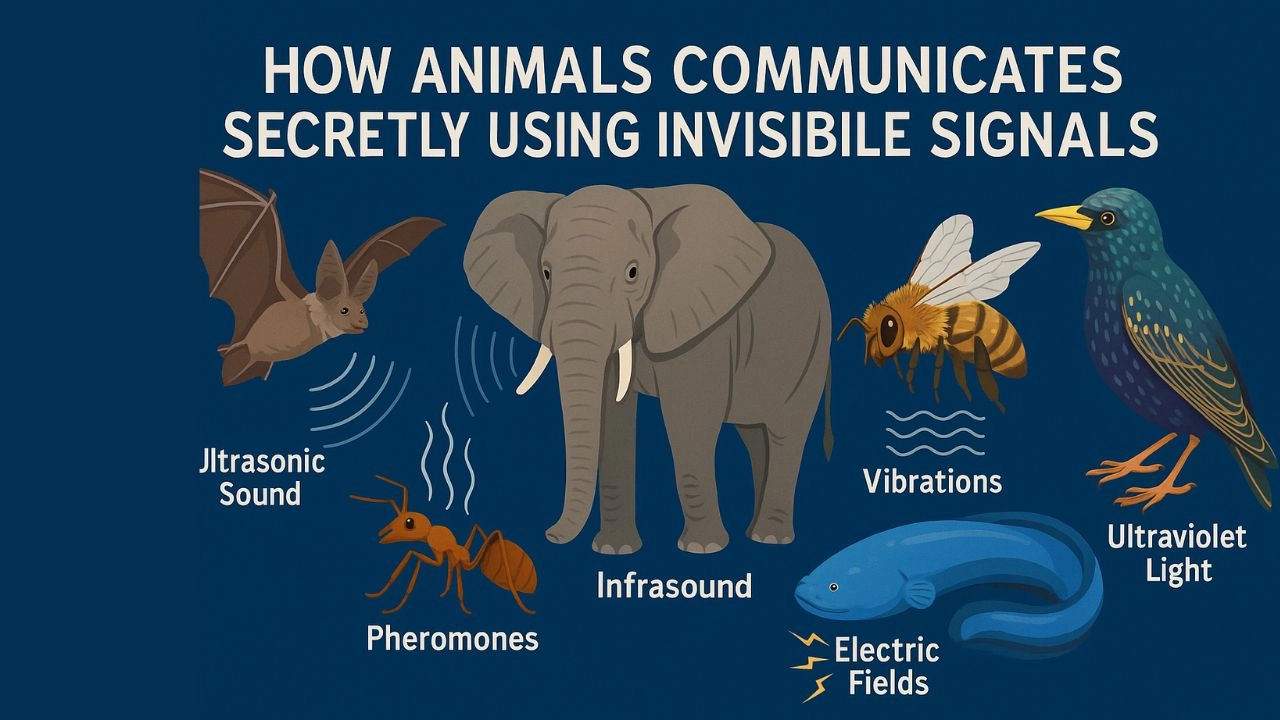
Animals communicate in countless ways, but some of the most fascinating signals are the ones humans cannot see or hear. While people rely mostly on speech and visible gestures, many creatures exchange messages through invisible communication systems—signals too quiet, too fast, too low, or simply outside the sensory range of the human body. They also Navigate Thousands of Miles Without GPS.
These hidden channels allow animals to share warnings, attract mates, mark territory and even navigate without ever revealing their presence to predators or competitors. The natural world is far more talkative than it appears, yet much of its conversation happens in silence.
One of the most extraordinary examples of invisible communication comes from ultrasonic sound, which exists at frequencies higher than human ears can detect. Bats use ultrasonic calls to locate insects, avoid obstacles and communicate with each other in the dark. Their vocalizations bounce off objects, creating a mental map. Rodents also use ultrasonic signals, especially newborn pups crying for their mothers. These secret sounds keep communication private, reducing the chance of alerting predators.
At the opposite end of the sound spectrum, some animals communicate using infrasound, which is extremely low-frequency audio that travels long distances. Elephants use infrasound to send messages through the ground and air, sometimes reaching miles away. These deep signals allow herd members to coordinate movements, warn one another of danger and locate mates far across the savannah. Whales use similar low-frequency calls that travel through the ocean for hundreds of miles, guiding migration and social bonding.
Another invisible messaging system involves chemical signals, known as pheromones. Ants rely heavily on pheromones to organize their colonies. A single ant can leave a scent trail that instructs thousands of others where to find food. Moths release airborne chemicals to attract mates over great distances. Even cats and dogs mark their boundaries with scent to declare territory. These chemical signals operate quietly, efficiently and often without any visible behavior.
Some species communicate through vibrations, sending information through soil, leaves, webs or water. Spiders feel vibrations on their webs to identify prey or potential mates. Frogs detect tremors in the ground that warn them of approaching animals. Bees perform vibration-based dances inside their hives, sharing directions to nectar sources with astonishing accuracy. These signals travel invisibly through the environment, forming a language built on touch rather than sound.
Light also plays a major role, though not always in ways humans can see. Many animals detect ultraviolet (UV) patterns that are invisible to the human eye. Birds use UV reflections on feathers to judge mate quality or species identity. Reindeer can see UV light on snow, helping them find food and detect predators such as wolves. Even some fish communicate through quick flashes of UV light underwater, creating a hidden visual code that predators cannot decode.
Electricity is yet another invisible channel. Certain fish, such as electric eels and elephantnose fish, generate electric fields around their bodies. These fields help them navigate murky waters, recognize individuals and coordinate movements. Their electric pulses form a silent communication network that allows them to detect objects and share social signals without speaking a word.
These hidden languages show how deeply animals rely on senses beyond human perception. While humans depend on sight and sound, most animals experience the world through a far richer and more complex range of signals. Invisible communication gives them the ability to coordinate survival strategies, strengthen social structures and avoid unwanted attention. Scientists continue discovering new forms of silent messaging, revealing that nature’s conversations extend far beyond what we can observe.
Invisible Communication Methods in Animals
| Communication Type | Species That Use It | Purpose of the Signal |
|---|---|---|
| Ultrasonic Sound | Bats, rodents | Navigation, feeding, mother–infant bonding |
| Infrasound | Elephants, whales | Long-distance alerts and coordination |
| Pheromones | Ants, moths, cats | Mating, territory marking, food trails |
| Vibrations | Bees, spiders, frogs | Communication through surfaces and webs |
| Ultraviolet Light | Birds, fish, insects | Mating signals and species recognition |
| Electric Fields | Electric eels, elephantnose fish | Navigation and social interactions |
FAQs
Q1. Why can’t humans detect most of these invisible signals?
Humans evolved with limited sensory ranges, especially in sound and light. Many frequencies used by animals fall outside human perception.
Q2. Are invisible signals safer for animals?
Yes, many animals use silent or hidden communication to avoid attracting predators while still coordinating with members of their group.
Q3. Do pets use invisible communication too?
Cats and dogs use scent-based communication, which includes pheromones. These signals help them mark territory and identify others.
Q4. How do scientists study signals humans can’t sense?
Researchers use special microphones, vibration sensors, UV cameras and electric field detectors to capture and analyze invisible communication.
Q5. Can these signals help humans develop new technology?
Absolutely. Animal communication has inspired innovations in sonar, radar, robotics, navigation and even wireless communication systems.